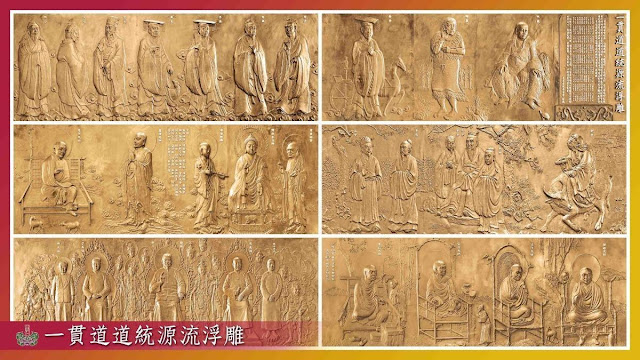
以下是藉由Gemini AI 產生的逐字稿
Before I begin, I would like to
express my deepest gratitude to the Grace of Heaven, the great virtue of our
Holy Teachers, the merciful guidance of our 老前人 and 前人 in heaven, and the kind arrangements made
by our Dao Transmitting Masters and lecturers. And thank you all for joining us
tonight. Today, we will continue our study of the Analects. If you scan
the QR code on the screen, it will take you straight to my YouTube channel. You
will find all the recordings of our previous Analects classes there, and
please feel free to check them out whenever you want to review.
In this online course, we
selected readings from the Analects. What we share are drawn from the 新民 Class teaching materials in our Dao
community. In the 新民 Class, these selected passages are
organized into six major themes, four of which we have already studied. The two
remaining themes are: the fifth, "The Conduct and Virtue of
Confucius," and the sixth, "The Aspirations and Conduct of His Disciples."
During our previous session in November 2025, we began exploring the sixth
theme. Today, we will be continuing with that theme: "The Aspirations and
Conduct of Confucius's Disciples (Part 2)."
儒家思想與一貫道的融合
I'd like to share a profound
quote with you all from the Holy Revelations. In the Holy Revelation titled The
Sacred Cauldron of Loyalty and Righteousness(忠義鼎聖訓當中), our Holy Teacher once said: "The continued
transmission of Yiguandao must be integrated with the philosophy taught between
the Zhu and Si Rivers."
As you might remember from our
class last November, the Zhu and Si Rivers refer to Confucianism. Our Holy
Teacher taught us that to spread Dao to the world, we must elaborate on the
Yiguan truth through Confucian teachings. Why? Because Confucianism is the
philosophy best suited for our time. 我們現在是儒家應運。As
cultivators, we don't live in isolation. We practice within our workplaces, our
families, and our society. Confucianism doesn't just focus on the origin of
mind and nature—儒家講的不只是心性,也講很多人倫常道—it also provides practical lessons for
getting along with others, handling everyday affairs, and fulfilling our human
relationships. It is deeply grounded in real life. Confucianism gives us a
clear explanation of the universal principles we must follow in all our
interactions.
向孔門弟子學習:陳蔡絕糧與十哲的由來
Since Confucianism is so
deeply, so closely connected to our daily lives, we must fully integrate the
philosophy of Confucius into our understanding and practice of Dao. But this
brings up an important question. As cultivators of the White Sun era, we may
ask ourselves: within the Confucian school, whom should we learn from? 既然是儒家應運,那我們該向儒家的哪一位聖賢來學習呢?
You see, whenever we think of
Confucius, 我們想當然是跟孔老夫子學囉! But we are so moved by his
greatness, the profound depths of his philosophy can sometimes feel far beyond
our reach. 孔老夫子太高了。However, we don't have to start at the very
top. As disciples of Jigong Laofou Buddha and Yuehui Bodhisattva, we can begin
by learning from the disciples of Confucius. 我們可以跟孔老夫子的弟子學啊,因為我們是濟公活佛以及月慧菩薩的弟子。
So, we've established that we
want to learn from the disciples of Confucius. But with so many disciples,
where do we start? History tells us that Confucius had 3,000 disciples. Among
them, 72 were highly accomplished. 三千弟子中有七十二賢, and
known as the "Worthies." And from these 72, there is a very famous,
specific group known as the "Ten Eminent Disciples." 七十二賢當中又有十哲。But how did these specific ten come to be
recognized? To understand this, we have to look at a time of great hardship.
During 14 years of traveling
among the feudal states, when Confucius was 63 years old, he was once stranded
on the road between the states of Chen and Cai. High officials of the two
states, out of selfish motives, placed Confucius under a strict house arrest.
They confined him and his disciples in a small house on the outskirts,
preventing them from moving freely. It was during this hardship that ten disciples
were by his side. They went seven days with nothing to eat at all, not even a
single grain. 十哲就是當初陳蔡絕糧的時候,陪侍在孔老夫子身邊的十位大弟子。
Later, upon returning to Lu,
Confucius looked back on those difficult days and said with emotions:
"Those who journeyed with me between Chen and Cai are no longer by my
side." And in the same passage, he categorized these disciples according
to their strengths. 孔老夫子把這十哲分為四科:
- 德行(In virtue): 顏淵、閔子騫、冉伯牛、仲弓
- 言語(In speech): 宰我、子貢
- 政事(In governance): 冉有、季路
- 文學(In literature): 子游、子夏
Thus, it was from this passage
that future generations recognized who the Ten Eminent Disciples were.
傳燈者的使命:開啟通往內在寶藏的玄關門
As you may remember from last
November, we planned to explore the disciples' aspirations and conduct in three
parts:
1.
Virtue
2.
Achievements
and Contributions
3.
The
Torch Bearers
We already covered the first
part about virtue in our last session. You might recall we looked at the noble
character of Min Ziqian, Ran Boniu, and Zhonggong. They are among the Ten
Eminent Disciples known for their virtue. When we talked about Min Ziqian's
indifference to fame and wealth(當我們談到閔子騫的淡泊名利的時候),
we mentioned another disciple. Even though he is not one of the Ten Eminent, he
is one of the 72. His name is Qidiao Kai, and we introduced him last time as
well. So we introduced four worthies.
Originally, I planned to share
the second part today: Achievements and Contributions. However, since our class
is only one hour today instead of the usual hour and a half, we will save
contributions for next time, and begin exploring the most important part: those
who carried the light forward, "The Torch Bearers."

Now, we come to the most important part of our series: Those Who Carried the Light Forward—The Torch Bearers. Among Confucius's disciples, who were the torch bearers that carried the light forward? There were two key disciples. They inherited the mission of the ancient sages, passing the torch of enlightenment to future generations. On the left is an image of a Holy Revelation bestowed by Patriarch Bodhidharma and our Holy Teacher, Jigong Laofou Buddha. The torch represents the transmission of the Heavenly Mandate passed from one generation to the next, shining through the ages. To understand the greatness of these two torch bearers, we must first look at a very special door.
This door has been sealed for
over 60,000 years. It is said that within this door, there is a boundless
treasure, but we do not have the key to open it. Ordinary people cannot open
this door. It requires a sacred hand holding the key of the Heavenly Mandate to
unlock it. When this door remains closed, everyone is left standing outside
because people cannot access their own inner treasure. They constantly beg and
seek outwardly. They use their six senses to chase after the six worldly dusts,
desperately hoping to obtain some fleeting happiness from the material world.
Unfortunately, things in life
are rarely, rarely go as we wish. 人生不如意事,十常八九。Most
of the time, the happiness we chase is just out of reach. When we can't get
what we want, it brings us pain, and this is what we call "the suffering
of unfulfilled desires"(求不得苦). Thus,
life becomes a sea of suffering.
But today, in the White Sun
era, the great universal salvation has begun. The enlightening teachers, Jigong
Laofou Buddha and Yuehui Bodhisattva, with the Heavenly Mandate, have descended
to the world holding this key. Our Holy Teacher, Jigong Laofou Buddha, has
already opened our heavenly portal. Now, it is up to us to stop wandering
outside. We must step inside, inside the door to explore our inner treasure. We
must retrieve our lost and wandering mind(把心收回來). Today,
during this great universal salvation, everyone has the opportunity to receive
Dao.
However, in ancient times, Dao
was strictly transmitted on a one-to-one basis. Confucius had to search among
the multitudes to find the single most qualified disciple to inherit the
Heavenly Mandate, making him the next enlightening teacher of that era. Sadly,
this chosen successor's life was very short. He passed away at the age of 32.
Because of this, Confucius had to find another to carry on the lineage, and
this brings us to today's focus. Among Confucius's disciples, we are going to
introduce the torch bearers who inherited the past and illuminated the future(繼往開來的傳燈者)—the ones who were entrusted with the key
to unlock this door.
復聖顏回:不違如愚,默逆聖意
There are two sages, two great
torch bearers of the Heavenly Mandate: Master Yan(顏夫子)is truly unique, and so is Master Zeng(曾夫子). They are both one of a kind, and their
roles did not overlap. Because Master Yan returned to heaven at a very young
age, Confucius, in order to pass down the Heavenly Mandate, chose another
outstanding disciple, Master Zeng. Next, we are going to explore the remarkable
characteristics of these two great sages.
Master Yan(顏回夫子)

Let's first look at Master Yan. He was 39 years younger than Confucius, yet he was undoubtedly his most beloved disciple. His courtesy name is Ziyuan, so he is also known as Yan Yuan. Even at a very young age, he reached an extraordinary level of spiritual cultivation. Throughout the Analects, Confucius praised him repeatedly for his profound dedication to Dao. His virtue was so great that over 1,700 years after his passing, later generations honored him as "Fusheng"(復聖). "Fusheng" means "the Sage of Restoration." This title truly recognizes him as a perfectly awakened sage who completely restored his original true nature.
To truly understand his spiritual attainment, let's now look at a few verses from the Analects. Yan Hui's first remarkable characteristic comes from Book 2, Chapter 9 of the Analects, where Confucius shares his profound observation of this beloved disciple.
Confucius said: "I can talk to Yan Hui all day, and he never disagrees with me, as if he were foolish. But when I observe his private conduct, I find that he fully puts my teachings into practice. Hui is not foolish at all."
子曰:「吾與回言終日,不違如愚。退而省其私,亦足以發,回也不愚。」
一、 如愚的修持境界
This brings up to a very important concept in Dao cultivation.
不違如愚 means "never contradicting, appearing as if foolish." Confucius said that he could teach Yan Hui all day, and Yan Hui would simply listen in total acceptance, never arguing back, as if he were foolish. But the key phrase here is "as if," as if, which means "to seem to be." In reality, he was silently absorbing the teachings with a pure heart. When Confucius observed how Yan Hui behaved on his own, away from the Master's presence, he realized that Yan Hui was actively applying all the teachings into his daily actions. Confucius then proudly declared, "Hui is not foolish at all."
二、 真智慧與純樸之心
如愚,Appearing foolish. In Dao cultivation, we often say... Now I want to share a Taiwanese proverb:「天公疼憨人」(Heaven loves the simple and the honest). Sometimes, being too worldly clever becomes an obstacle to cultivating Dao. True spiritual achievement belongs to those with a pure, honest heart. True wisdom isn't about debating, 真正的智慧不是在辯論。
三、 依教奉行與修學本質
And 亦助發. In this passage, we explore 如愚 and 亦助發. It's
about... 亦助發 means it's about obediently practicing
what the Master teaches. To learn without practicing is like entering a
mountain of treasures but returning empty-handed.「學而不習的話,就如同入寶山而空手回」。Confucius proudly declared, "Hui is not foolish
at all." He actually meant "Hui is full of wisdom." So this is
his first quality, appearing foolish, but actually he was full of wisdom. Then
what is the next characteristic we can learn from?
四、 孔子讚顏回之好學
Let's look at Yan Hui's second
characteristic: his love of learning.
Duke Ai... not Duke AI, Duke Ai, 魯哀公.
Duke Ai once asked Confucius which of his disciples loved to learn the most. Confucius gave a very specific and impactful answer. Confucius replied, "There was Yan Hui, he loved to learn. He did not transfer his anger. He did not repeat his mistakes. Unfortunately, his allotted time was short, and he died. Now, there is no such person. I have not heard of anyone who loves to learn."
「哀公問:『弟子孰為好學?』孔子對曰:『有顏回者好學,不遷怒,不貳過。不幸短命死矣,今也則無,未聞好學者也。』」
五、 好學的深層意涵:不遷怒
Now we explore 好學, and the content of 好學 includes 不遷怒 and 不貳過. Today, we define 好學, loving to learn, as getting good grades or earning a prestigious degree. But to Confucius, true learning is spiritual cultivation: not transferring anger and not repeating mistakes. Let's talk about not transferring anger first.
How do we define not
transferring anger? Usually we think not transferring anger means not taking
out anger on innocent bystanders, right? But our Holy Teacher gave us a much
deeper teaching. Our Holy Teacher asked us, "Who generates the
anger?" We, right? For example, "I'm angry." It's me who
generates the anger. So we generate the anger. Therefore, this anger is our own
responsibility. The person who generates the anger must take responsibility for
his own issue. So we must subdue it ourselves. Even if we vent our anger on the
person who provoked us, we are still transferring our internal issue onto
someone else. So real "not transferring anger" means we must adjust
our own mindset, not to vent our anger on somebody else, even if that somebody
is the one who provoked us. Because anger is our own internal issue. And be
responsible for our own internal issue and subdue our own anger, and that is 不遷怒, not transferring anger.
六、 克己功夫:不貳過
Then what is 不貳過, not repeating mistakes? Some people said not repeating mistakes means you can do every bad deed just one time, you can do every bad deed just once, not twice, then you are practicing not repeating mistakes. We all know that it is a joke, of course not.
Our Holy Teacher defined it perfectly. As humans, we all have moments of weakness. And the very first mistake is the arising of a negative thought. When we have a negative thought, we have made the first mistake. If we have a negative intention, then we have the first mistake. And then if we allow that thought to manifest into negative words or action, then that is the second mistake. So "not repeating mistakes" means don't put your wrong thoughts into actions. To not repeat a mistake means catching the negative thought at its root and transforming it before it becomes an action. It sounds simple, but it requires incredibly strict self-discipline. And Yan Hui could do this, which is why Confucius praised his love of learning. And because of this high standard, Confucius made a very heavy statement.
七、 顏回修持的獨特性與同修的敬服
Confucius then said, "Now, there is no such person. I have not heard of anyone who loves to learn."「今也則無,未聞好學者也。」 Confucius concluded with his heavy and shocking statement. 孔老夫子講重話. He spoke these words to awaken his other disciples, urging them to rise up and emulate Yan Hui as their role model.
Faced with such a high standard from the Master, 其他弟子怎麼想呢?會不會很嫉妒,為什麼老師獨獨鍾愛顏回呢?其他弟子啊,wholehearted acceptance. The other disciples still accepted whole-heartedly because Yan Hui was so entirely dedicated to inner cultivation. No one felt any jealousy or unfairness. Just how dedicated was he? Let's look at the next chapter to find out.
八、 三月不違仁:純一不雜的聖賢心境
Confucius said, "As for Hui, his heart for three months does not deviate from Ren. The others may only attend it for a day or a month."「子曰:『回也,其心三月不違仁,其餘則日月至焉,而已矣。』」
Yan Hui's third characteristic: unwavering focus on inner cultivation. Confucius said that Yan Hui could maintain his heart without deviating from Ren for three months. But what exactly does Ren mean here? And why three months?
Ren: The ultimate meaning of Ren taught by Confucius is our heavenly conscience. It is our original, pure, true nature. Yan Hui could guard this heavenly conscience perfectly.
And what about three months? When Confucius said "three months," he doesn't literally mean 90 days. In Chinese numerology, the number "three" can represent a complete, perfect cycle, just as we speak of the "Three Eras"(三期)or the "Three Realms"(三界). So "three months" means Yan Hui dedicated himself completely and constantly to guarding his true nature. The other disciples could only achieve this occasionally, maybe for a day or two or a month, and stopping and starting, 活捉、活捉(或作「或作或輟」). Yan Hui's focus was extraordinary. And because of this deep focus, he found true spiritual joy. How did he practice this? Let's look at another chapter.
九、 克己復禮為仁之具體條目
To understand how he achieved this state, 三月不違仁, we look at Book 12, Chapter 1. Yanyan asked how to attain Ren. Confucius gave him the ultimate formula.
Confucius replied, "To subdue oneself and return to Li, this is Ren. If one day you can subdue yourself and return to Li, the whole world will be included in your spiritual light. And Ren rests within yourself, how could it come from others?" Yanyan then asked, "May I ask about the steps in this process?" The Master replied, "Look not at what is contrary to Li. Listen not to what is contrary to Li. Speak not what is contrary to Li. Make no movement which is contrary to Li." Yanyan said, "Although I may not be wise or clever, I will do my utmost to follow these words."
「顏淵問仁。子曰:『克己復禮為仁。一日克己復禮,天下歸仁焉。為仁由己,而由人乎哉?』顏淵曰:『請問其目。』子曰:『非禮勿視,非禮勿聽,非禮勿言,非禮勿動。』顏淵曰:『回雖不敏,請事斯語矣。』」
十、 以施除私與六根的修持
Let's break down this formula. What does it mean to subdue oneself, 克己?
克己: Overcoming the false self and selfish desires. What is oneself? It is the small self(小我), false self(假我), the physical body and its selfish desires. Our Holy Teacher shared a profound revelation: eradicate selfishness through giving,「以施除私」. Through external merits, we can also subdue ourselves with a generous, giving heart to eliminate our hidden selfish motives. When we talk about subdue oneself, subdue our false self, we think about meditation. But here, Holy Teacher teaches us through external merits(行外功), 也可以「以施除私」喔.
In this beautiful holy
revelation, you can see a big character "施"(Given)right in the
center of the Dharma wheel. Our Holy Teacher is telling us to turn the Dharma
wheel of giving through material donation, Dharma sharing, and volunteering
service in order to eradicate selfishness through giving,「以施除私」.

And then where does this
selfishness, this small self, this false self, come from? It comes from the six
roots. Normally, we hear about the five senses. And five senses plus the mind
make up the six roots.

So we can see here: look not, listen not, speak not what is contrary to Li. And for the rest of the six senses: nose, body, and mind, move not. Confucius told Yan Hui to guard these gateways. Do not look, listen, speak, or act contrary to Li. Guarding what we see, hear, say, and do is exactly how we purify these six roots. By purifying his six roots, Yan Hui had attained Ren, a very high spiritual level, very high spiritual state.
And what does "returning to Li"(復禮)actually mean? 復禮又是什麼呢?
The Chinese character Li(禮貌的禮), in the Book of Rites(《禮記》)裡面, Confucius said「禮者,理也」, meaning that 禮貌的「禮」跟真理的「理」是通的. Meaning that Li can also mean principles,
principles that align with truth. Since Li can also refer to principles in
harmony with the truth, then the truth within ourselves is precisely our true
nature. 那我們每一個人……
一、 克己復禮:體用兼備的修持
那內在真正的「理」是什麼呢?就是我們的自信(自性)啊。
Therefore, we can elaborate fu
li as returning to one's true nature. 所以我們可以把「克己復禮」的「復禮」解釋為回復本性。
And also we can explain as
returning to propriety, because the outward manifestation of our true nature is
propriety. Why? Because a person successfully preserves their true nature,
their every outward action, every word, and behavior naturally flows with Dao,
and this outward manifestation is propriety.
So, both explanations make
perfect sense, and actually we need both. One is about the essence, and the
other is about the application. 一個是體,一個是用。If a
person can restore their true nature, 回復本體,then their
outward action naturally returns to propriety.
顏回 was incredibly focused on his inner
cultivation. This focus, combined with one more characteristic, allowed him to
become a sage at a very young age. So, what is the next characteristic?
二、 顏回的第四特質:精進不懈
Number four: Relentless
diligence.
This is Yan Hui's fourth
remarkable characteristic: His relentless diligence and unceasing advancement
in spiritual cultivation. Here we have two profound chapters from Book 9 of The
Analects, where Confucius praises his absolute dedication.
The Master said, "As for
one who never grows lazy after being told, is it not Hui?"「語之而不惰者,其唯回也與!」
The Master said of Yan Yuan,
"Alas, I saw his constant advancement. I never saw him stop."「子謂顏淵曰:『嘻乎!』(很可惜,因為他很早就回天了)『吾見其進也,未見其止也。』」
Let's look at the first passage
first.
三、 聞道即行與孔子的嘆惜
The first passage is "The
one who never grows lazy after being told"(語之而不惰). When Confucius taught him a principle, 顏夫子 would immediately put them into diligent
practice. He never slacked off, he never slacked off, 從來不偷懶. Among all the disciples, only Yan Hui
possessed this extraordinary level of dedication, tirelessly practicing what he
had learned without a single moment of laziness.
But tragically, his life was
short. So Confucius said, "Alas!"(很可惜喔)—A profound
sorrow for a lost talent. "Alas," this expresses his deep sorrow
because this incredible talent had already passed away.
「吾見其進也,未見其質(止)也。」But looking back at Master Yan's life,
Confucius gave him the highest praise: "I saw his constant advancement, I
never saw him stop." And from the beginning to the end, Confucius only saw
Yan Hui continuously making the effort to refine his spiritual state; he never
saw him slacken his efforts or become idle. And because of this relentless
spiritual cultivation, he was able to discover the profound, so-called「孔顏樂處」(Joy of Confucius and Yan Hui). Let's look at the next slide to
understand this joy.
四、 顏回之樂與顏子不改其樂
The profound joy of Confucius
and Yan Hui.
The Master said,
"Admirable indeed was the virtue of Hui! With a single bamboo bowl of
rice, a single gourd of drink, and living in his mean, narrow alley, while
others could not have endured the distress, his true joy remained perfectly
unchanged. Admirable indeed was the virtue of Hui!"
「孔顏樂處」was the later Confucian philosophers, 宋明理學家,studying about 1,000 years ago. Those
philosophers were deeply fascinated by this: What exactly were they so happy
about—Confucius and 顏夫子?
Confucius could still play his
lute when he was starving in Chen and Cai. 陳蔡絕糧,孔老夫子弦歌不輟.
And here, 顏夫子 lived with just a single bowl of rice and
a gourd of water in a narrow, run-down alley. Others could not bear the
hardship, but he never changed his joy. And what was he so happy about? And
this brings up a very common misunderstanding.
五、 化解對安貧樂道的誤解
Some people might think Yan Hui
is telling us: to cultivate Dao, we must seek extreme poverty and do nothing.
Once a friend told me, she said, "I definitely don't want to be like Yan
Hui. I don't want to live on just a bowl of rice and a gourd of water and doing
nothing. I have a lot of things to do, I have a lot of things to
accomplish." And actually, this is a misunderstanding that wrongs our
sage.
顏夫子 is not telling us to pursue extreme
poverty. The reality is, while a cultivator seeks no material luxury, worldly
resources are essential to propagate Dao. Propagating Dao constantly requires
worldly resources; 辦道需要資源喔. Material donation(財施)is like water, and the Dharma boat needs
water to sail. And building temples and helping others all require material
support. Therefore, our goal isn't to be completely destitute. Of course not.
So, if he wasn't glorifying
poverty, what was he trying to show us?
六、 自性真樂與不為外物所惑
His true joy remains perfectly
unchanged when he was in poverty. What Yan Hui showed us was not that we should
pursue poverty; what he wanted to reveal is the precious value of cultivating
Dao. Even when living in a kind of poverty that most people would find
unbearable, his inner joy never changed.
And why is that? Because every
person possesses Buddha-nature, and the true joy within the Buddha-nature
cannot be bought with material things. So when a person discovers the true
richness within their own heart, they are naturally no longer attached to external
wealth.
所以佛性裏頭的真樂,不是錢可以買來的。如果有人找到他內在的真樂的話,就不會被外在的財富所迷惑。
If such a person happened to
possess great riches—所以一個找到自性真樂的人,如果他碰巧家財萬貫,what would he do? He would use his wealth
to benefit others, he would practice great generosity. Would he become a miser,
clinging to his money? Of course not!
And if, on the other hand, he
happened to be completely poor—所以一個找到自性真樂的人,如果碰巧他一貧如洗,那他會怎麼做呢? He could still live with happiness and dignity, 他仍然很快樂地頂天立地,他沒有任何的自卑。Would he feel unlucky? Would he feel
inferior to others? No, he would not. 這就是顏夫子要告訴我們的。
七、 孔顏樂處的真諦
So what Yan Hui truly
demonstrated is the profound value of cultivating Dao. The true joy of life
does not lie in fame, does not lie in profit, does not lie in power, and does
not lie in wealth. And that is exactly why Confucius praised him from the bottom
of his heart, saying, "Admirable indeed"(賢哉回也,那是「回」).
Now, let's explore deeper: How
exactly did he find this true inner joy, and what is the source?
To answer how he found this
true joy, we must look at the passage. Confucius gives us the key:
The Master said, "As for
Hui, his spiritual state is near to perfection, he is frequently empty."「子曰:『回也其庶乎,屢空。』」
八、 「庶」與「屢空」的修持功夫
「庶」—There are two meanings for this word shu.
The first one is shu ji(庶幾), which means "almost." So when
it means "almost," it means Yan Hui's spiritual state had almost
reached absolute perfection. And the second meaning is "abundant,"
inwardly abundant. When it means "abundant," it means even though he
lived in poverty, his inner heart was profoundly rich and spiritually abundant.
And both interpretations are excellent.
But what does the second
phrase, lü kong(屢空, "frequently empty")really mean? Does it mean his pockets were
empty?
It means he was continuously
emptying himself of negativity. He repeatedly corrected his faults and
eliminated his bad temper. 「屢空」就是說顏夫子呢,不停地改毛病、去脾氣。說顏夫子不停地改毛病、去脾氣不是後學說的,這是道師在《十五條佛規》「慈悲」所講的喔。
This is not just my personal
interpretation. In the 15 disciplines, specifically the first discipline,「尊敬仙佛」那條佛規(Revering the Buddhas), our Holy Teacher mercifully explained
Master Yan focused entirely on correcting his faults and eliminating his bad
temper; he was constantly cultivating inward.
九、 掃去雲霧,重現自性明月
And why did he do this? Because
our true nature is like a bright full moon, inherently complete with all
virtues and wisdom, originally pure and joyful. However, the pollution of the
human mind acts like dark, heavy clouds, obscuring this inner light and
abundance.
Yan Fu-zi's practice of being
frequently empty was exactly the process of pushing away these clouds. By
constantly clearing away his faults and worldly distractions, he didn't gain
anything else—他沒有得到任何新的,只是回復本來—he simply revealed the radiant moon that
was already there, rediscovering his true, unchanging inner wealth.
He emptied himself again and
again. And how deep did this emptiness go?
Until the ultimate void
appears. Lü kong means emptying and emptying again and again. Just as
the Classic of Purity and Stillness—《清靜經》說「觀空亦空」,所以「空無所空」嘛—when emptiness is emptied of emptiness, and there is nothing left to
empty,「所空既無,無無既無;無無既務,湛然常寂;寂無所寂,欲豈能生?欲既不生,即是真靜」,and that is true stillness.
And look at the central holy
lamp, 母燈. 來,我們請恭敬地看母燈喔. In
our temple, behind the flame are the characters「無極」(The Ultimate Void).
The luminous heavenly realm, 無極理天, is the ultimate state of wu(nothingness). If Yan Fu-zi hadn't continuously corrected his faults, let go of
attachments, and completely emptied his mind of all ego and worldly
distractions, how could he have attained such boundless joy? 如果他沒有「屢空」的話,他就得不到這個真樂。And this is the true meaning of
"frequently empty."
So does this mean he just sat
around and doing nothing at all? Did he just do nothing?
Now hearing all this about
emptiness and stillness, we might have a question: Did Yan Fu-zi just sit there
completely empty and doing nothing all day? To understand his greatness in
action, we must look to Mencius. If we hadn't read the Book of Mencius,
we would never fully understand the true greatness of Yan Fu-zi's actions.
When people hear about Yan
Fu-zi living in a poor alley with just a bowl of rice...
對顏回的常見誤解與孟子的解答

A common misconception arises. People think, "Oh, he was just passive."(他老是很被動的)"He was a hermit."(他就是個隱士)who withdrew from the world and only cared about himself.(他只顧自己)To answer this, another great sage, Mencius, compared 顏夫子 to two ancient legendary compassionate sages. 如果沒有讀《孟子》,還不能理解喔,孟老夫子把顏夫子跟兩位大聖人來做比較喔:One great sage saved the world from a catastrophic flood,(治水有功的偉大聖人大禹王)and the other saved the people from starvation,(后稷,教人民種稻穀). So people's misconception was: Was 顏回 just passive and avoiding the world? Mencius had the answer, 孟老夫子有答案了。
聖人的同理心與異地皆然

The two great sages had such a profound empathy that when they saw people drowning(大禹王)or starving(后稷), they felt as if they were drowning and starving themselves. 他們是「人溺己溺,人飢己飢」啊! They were so busy saving the world that they passed by their own homes without even entering. 他們是「三過家門而不入」啊! Compared to these active world-saving sages, 顏夫子在這裡喔,this humble philosopher and spiritual cultivator seems to be doing nothing. But was he really just a passive man? 他真的是這麼被動、這麼消極嗎?
Now we see a scale, 一個天平 on the screen. If we put the world-saving
sages(把這個拯救世人的大聖人)on one side and 顏夫子 on the other side, and weigh them(秤秤看)—whose virtue do you think carries more
weight? 誰的德性比較重呢? Mencius said they have equal greatness.
When they swap places, they demonstrate equal greatness.
Mencius revealed a profound
truth: This philosopher and those world-saving sages had attained the exact
same spiritual state. 顏夫子 possessed the exact same immense
compassion and capability to save the world. So why didn't he? Because those
sages lived in an era where righteous action could actually make a difference,
while 顏夫子, on the other hand, lived in a dark,
corrupt time ruled by ruthless tyrants and predators. 顏夫子生活是在亂世當中啊,他沒有辦法施展他的抱負啊!
Mencius explained this
perfectly: "易地皆然". If they changed places with each
other, they would do exactly the same thing. If Master Yan faced the Great
Flood, he would step forward to save the world with all his heart. And if those
ancient sages lived in Master Yan's corrupt time(如果大禹王、后稷也生在春秋時代的話), they would also choose to live a simple life in that
poor alley. They would keep their inner joy and refuse to work for the bad
rulers. Their pure hearts were exactly the same, only their life situations
were different, and this is the true greatness of a sage.
So, what if Master Yan were
born today? Think about it. We talk about 顏夫子 and 大禹王、后稷「易地皆然」. What about Master Yan born today, in the
White Sun era—a time when the Great Dao is widely propagated? Without a doubt,
he would fully dedicate himself to cultivating and spreading Dao. Just as
Mencius said: "天下溺,援之以道". 當然啦,他一定會做「天下溺,援之以道」。
孔子對顏回的最高讚譽与「用行舍藏」
Now we come to the highest
praise Confucius ever gave to Master Yan. Confucius said to Master Yan(對顏回):"When called, I serve; when set aside,
I withdraw. Only you and I can live this way."(「用之則行,舍之則藏,惟我與爾有是夫!」)
What does this mean? "When
called, I serve" means when the time is right and the world needs us, we
step forward to serve and benefit the people. And "when set aside, I
withdraw" means if times are bad or people don't need us, we peacefully
step back. We withdraw from the spotlight and stay perfectly happy in our
simple life without asking for more.
And this reminds me of... In
the past, we often heard our 老前人's
compassionate words. 以前常常聽到老前人慈悲這樣講:「人家需要我,我就去;人家不需要我,我就走。」老前人常常這樣講。我們那時候年輕,不曉得這句話有什麼了不起,原來這句話就是「用行舍藏」啊! In the past, 老前人 always said: "If a place needs me, I
will go there. If I'm no longer needed, I will simply leave." And this is
exactly carrying the same meaning of what Confucius said: "Only 顏回 and Confucius can live this way."
And this sounds easy, but it is
incredibly difficult. In the real world, ordinary people often do the opposite.
Sometimes, when ordinary people are called to serve, but they feel too much
pressure, they make excuses and run away—and that's "called, but don't
serve." And other times, when they are set aside, but they complain that
life is unfair and they feel bitter—they "set aside, but don't
withdraw." 但是有時候他們不為人所用,他們又抱怨懷才不遇;那人家要用他,他又覺得壓力太大、不能承擔。
But Master Yan was different.
He reached the beautiful state described in the Classic of Purity and
Stillness. 顏夫子做到《清靜經》的「常應常靜,常清靜矣」—Always responding, and always still. When
things come, he responds perfectly. When things pass, his mind returns to
perfect peace. And this is why Confucius gave his beloved disciple the highest
praise: "Only you and I can live this way."
師徒間的情誼與顏回之死
The eighth characteristic: A
deep spiritual bond between the Master and the disciple. When the Master was in
danger in Kuang(匡地,the place called Kuang), 顏淵 fell behind.
The Master said: "I thought you were dead." 顏淵 replied: "While you are alive,
Master, how dare I die?"(「子畏於匡,顏淵後。子曰:『吾以女為死矣。』曰:『子在,回何敢死?』」) Once Confucius was surrounded by enemies and in great
danger in Kuang, which is a district of the State of Wei(衛國的一個匡地). 顏回 fell behind.
When 顏回 finally caught up, Confucius said: "I
thought you had been killed." 顏回 replied:
"While you are still alive, Master, how would I dare to die?" And
this beautiful reply shows his absolute loyalty and love for his teacher.
Sadly, life is impermanent. 顏淵 died at a very young age. 顏淵 died, Confucius cried out in deep sorrow:
"Ah, Heaven is destroying me! Heaven is destroying me!"(「噫!天喪予!天喪予!」) Why did he say this? Because 顏回 was the only one who truly understood the
essence of his teachings. Confucius was heartbroken because he had lost his
chosen successor to inherit and pass on the torch of enlightenment.
Then comes the most powerful
moment. 顏淵 died, the Master wailed for him. A
follower said: "Master, your grief is too much." The Master replied:
"Is it too much? If I do not cry bitterly for this man, who else should I
cry for?"(「顏淵死,子哭之慟。從者曰:『子慟矣!』曰:『有慟乎?非夫人之為慟而誰為?』」) Confucius replied this question with
another unforgettable question: "If I do not cry bitterly for this man,
who else should I cry for?"
聖人的考驗與道脈傳承

Let's look at this Confucius timeline. In just a few short years, Confucius suffered one heartbreak after another:
- At the age of 69, his only son passed away.
- At 71, he lost his greatest successor, 顏回.
- At 72, his brave student, 子路, died.
- And finally at 73, Confucius himself returned to
Heaven.
So looking at his whole life,
it might seem tragic and full of sorrow. But my friends, this is exactly how a
great sage is born. We must understand a profound truth: Worldly success does
not equal to Heavenly glory. 世間的成功並不代表天上的果位。In
fact, sometimes the deepest suffering on Earth(有時候人世間的淒淒慘慘)creates the highest glory in Heaven(正創造天上的輝煌).
For a great patriarch, the
continuation of the Dao lineage is absolutely crucial. Yet 顏回 passed away when Confucius was 71, and
Confucius himself returned to Heaven at 73. Time was running out. In those
short one or two years, Confucius faced a critical moment: He had to pass on
the torch of enlightenment before he left the world. The lineage of Dao could
not be broken—道脈不能斷啊! Luckily for all of us, at this exact
moment, another great disciple with a deep spiritual foundation appeared.
宗聖曾子的出現與結語

Master Zeng(曾參夫子)appeared to continue the lineage, courtesy name 子輿, revered as 曾子 in The Analects, and for later generations, they revere him as 宗聖, the lineage sage.
In The Analects, 曾夫子 is revered as 曾子. "子" means
Master. You might wonder, why wasn't 顏回 called
"Master" back then? Because Confucius was still with them. So out of
respect for their teacher, disciples wouldn't let others call them
"Master", though later generations did honor 顏回 as 顏子. And because 曾子 successfully continued the orthodox
transmission of Dao, he was given the title "The Lineage Sage"(宗聖). He was the key person who ensured the
continuation of the Dao lineage at that time. To bear such a heavy
responsibility, 曾夫子 possessed many outstanding
characteristics, too.
But we don't have time to
explore. So maybe let's leave 曾夫子's
characteristics next time in September. We will share the characteristics of 曾夫子 next time.
And again, the QR code on the screen will take you to the video recordings of previous Analects lectures on my YouTube channel. Please feel free to check them out. And finally, if I have misspoken in any way today, I humbly beg God and the Buddhas for forgiveness.